Sunday, April 11, 2010

The Outsiders


The devastation of the First World War shook Europe and the rest of the globe in a new and deeply profound way. Apart from the great political and economic ruin, the loss of an entire generation of young men drastically transformed the social structure of the nations involved. However, in the wake of this wreckage emerged a powerfully radical movement in art and literature: modernism. Disillusioned by greater social institutions like religion or government, modernism is characterized by a definitive break with tradition. Modernist works emphasize the overall subjectivity of existence, and are often fragmented, filled with obscure references to the larger canon of literature, and defined by feelings of alienation.


Wassily Kandinsky - Composition VIII


Around the same time as works like T.S. Eliot's The Waste Land and James Joyce's seminal Ulysses were being written and published, the world of art was being reevaluated as well. Where the "point" of a story or poem shifted from telling a story to portraying some emotion or experience, the same can be found in the visual media as well, like these two paintings by Kandinsky and Mondrian. By painting these abstract images and colors, Kandinsky and Mondrian found an outlet for expressing emotional perceptions. In the "Proteus" chapter of Ulysses, the protagonist Stephen is wandering along the beach thinking about what he calls the "ineluctable modality of the visible," or the failure of sense to adequately capture the outside world. Kandinsky and Mondrian similarly believed that what is seen is inherently false, and that true reality couldn’t be captured in any visual image, so they focused on expressing their individual experiences alone.


Piet Mondrian - Composition II in Red, Blue and Yellow


It is interesting to consider how the Modernist painters developed the theme of alienation through their artwork. In this painting by Mondrian, for example, the return to primary colors (red, blue, and yellow) suggests the failure of advancement to adequately provide for their needs. There is new emphasis placed on the formal elements, like shapes and lines, as if what is being said is possibly secondary in importance to how it is being said. Although the red is undeniably the largest block of color in the frame, it doesn't seem unbalanced, but rather the tension of the painting stems from the juxtaposition of neutral black and white to "hold in" the fiery red. Because there is no human or other discernible figure in the painting, the meaning must be derived in the connection of the viewer to the canvas. It goes back to Ulysses' mediation on perception, and Mondrian's painting invites the eye to take it in by focusing on what is essential to sight, these specific colors. When the contrasting shades of black and white are added, the composition becomes an allegory for possibility, and the very nature of existence (although it is also important to emphasize the inherent subjectivity of an analysis like this!)


To further develop the rooted theme of alienation, another connection these artists have to the many other great leaders of the modernist movement like Joyce, Stravinsky, Bartok, Picasso, Miro, Pound, Hemingway, Fitzgerald, Auden, Huxley, Mann, Eliot and Beckett, is that all their creative masterpieces were created in states of exile, either because of war or for other personal reasons. The early-to-mid twentieth century was a time of great paradigmatic shifts in society, where national loyalty was being questioned and where the international political superpowers were changing in shocking ways. Britain, who once controlled half the world, was facing the apocalyptic aftermath of WWI and being eclipsed by their formal colony the United States, financially, politically and even culturally. Few of the great British writers on the early 20th century originated or stayed long in Britain and, as literary critic Terry Eagleton best describes it, Britain had sunk to the point where it was forced to import its modernists. Nevertheless, this distance gave the writers and painters an interesting role as outsiders commentating on the social state of affairs.


Among the many articles written on this topic, Doris Elder in "Three Writers in Exile" poses the following questions at the end of its introduction, that may be useful to keep in mind in regards to three authors in particular: T.S. Eliot, James Joyce, and Samuel Beckett, all of whom defined their field through their new and innovative writing, all the while in exile.


  • Why did each writer settle where he did?


  • How did exile make possible or facilitate his work?


  • How did each writer influence his chosen environment and, likewise, how did his environment influence him?


  • What did each writer retain of his native heritage?


  • What do these authors' works reveal of the state of American, British, and European culture during the first half of this century?


  • What can we learn about the problem of the alienation of the modern artist by studying the lives and works of Beckett, Eliot, and Joyce?


Eliot summed it up the best in his poem The Four Quartets where he says:


We shall not cease from exploration, and the end of all our exploring will be to arrive where we started and know the place for the first time.

The Exile's Guide to Europe


Be them exiles, expatriates or refugees, the story of the modernists is a story of people without a home. According to John Cawelti in Eliot, Joyce and Exile the rise of modernist exile stems from two causes:


One is historical and political. The twentieth century brought to a culmination the rise of nation-states and the growing conflicts between them that led to two major wars. Though nationalism was an important factor in nineteenth-century art, it reached an obsessive level at the turn of the twentieth century. As conflicts between European nations intensified, definitions of national loyalty became increasingly rigid and narrow, a pattern heightened by the communist and fascist revolutions and their demands for party loyalty. Political and ideological dissenters were forced into exile to avoid imprisonment or execution.


At one time or another during their lives, Joyce, Beckett, and other artists such as Stravinsky and Mondrian were forced to leave their country because of their ideological beliefs or nationality. Many artists however, like Eliot, were not forced to become exiles, but instead chose to leave. For this second group:


exile was a chosen way of life. Motives leading individuals to become expatriates were highly various but usually reflected dissatisfaction with the conditions of artistic or intellectual life in the homeland. Following in the footsteps of Henry James in the later nineteenth century, Gertrude Stein, Ezra Pound, and T. S. Eliot left America for Europe. After World War I, Hemingway, Fitzgerald, and Dos Passos, among others, went to Paris, drawn by the lively artistic climate of that city, but also seeking to escape America's new prohibition of alcohol and take advantage of the lower cost of living in postwar Europe.


a Paris opera house in the early 20th century


In the map below, we will see the journey that a selection of these writers, artists and composers took during their exiles. Each colored line represents a different person and if you click on the line it will provide a description of their route and their motivations. As Cawelti notes, you can see in the map that after World War I, many artists congregated around the hot bed of art in the early 20th century, Paris. Many intellectuals had come over to Europe to fight in the war and the favorable exchange rate, lax drinking laws and a burgeoning artistic scene of Paris convinced many to stay. These writers, including Gertrude Stein, F. Scott Fitzgerald and Hemingway, were joined by other European expatriates and became the foremost writers of the high modernist movement during the 1920s. Unfortunately, the increasing political tensions leading up to World War II made Paris and much of the rest of Europe unsafe for these artists. Some, like Samuel Beckett, identified with their adopted country and joined the French resistance. Others fled either to the neutral country of Switzerland or to the United States, moving mainly to New York and Los Angeles. Large expatriate communities developed in these cities elevating the United States as the home for a new generation of exiles.


Click the lines to learn more or click HERE to see a full size map and HERE for a map of James Joyce's extensive travels!

The Eliot Effect


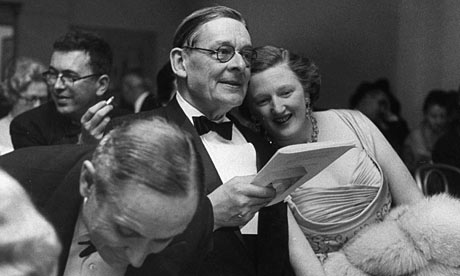
T.S. Eliot bears the rare distinction of being considered one of the best national writers of both Britain and America. Although he was born in Missouri, he moved to Oxford when he was twenty-six and it was in England that he gained so much fame and recognition that the British soon claimed Eliot as one of their own. Eliot's writing spoke to the disillusionment felt by the nation after the horrors of the World War I. Through the use of alternative writing styles, fractured narrative and the use of multiple languages in his seminal work, The Waste Land, Eliot brought together a nation by providing a voice for the feeling of alienation that had insofar been inexpressible. His adventurous style also helped cement his role as a leader in the modernist movement and revive Britain's status as a center for literature. This couldn't have come at a better time for England as despite its past acclaim as a artistic force in the 1800s with the Romantic poets, in the early years of the 20th century it was struggling with a dearth of creativity. As Terry Eagleton notes,

"Stiflingly provincial and primly closed to artistic experiment, imperial England had to import its modernism, as later it was to import its literary theory and developing-world novelists. Most of these emigrés were displaced, migrant souls, half in and half out of English society"


Eliot was one of these "migrant souls" moving to England for school and then never leaving. Eliot never could become entirely English but it wasn't from lack of trying, Eagleton refers to Eliot as one of the "Yankee dandies who became more English than the English." He officially became a British citizen in 1927 and unhappy with his Unitarian faith, he converted to Anglicanism, the official church of England, eventually becoming a warden of his local church. He enjoyed popular British past times-such as the music halls that will be discussed in the next post and wrote a series of politically conservative essays titled For Lancelot Andrewes where he espoused royalist views. His assimilation into British life coincided with his remarkable rise to success. A biography of Eliot by Ronald Bush declares that:

As early as 1926 he delivered the prestigious Clark Lectures at Cambridge University, followed in 1932-1933 by the Norton Lectures at Harvard, and just about every other honor the academy or the literary world had to offer. In 1948 Eliot received the Nobel Prize for literature during a fellowship stay at the Princeton Institute for Advanced Study. By 1950 his authority had reached a level that seemed comparable in English writing to that of figures like Samuel Johnson or Samuel Taylor Coleridge.


Eliot's anglophilia became such a part of himself that it even affected his manner of speech. I the clip below, a reading from The Four Quartets you can hear the strange and easily recognizable manner of his voice . It seems unusual for someone born in the United States to have such a pronounced British accent but some have suggested that Eliot's seemingly over-affected speech may have been his way of concealing his midwestern roots, which was quite at odds with the cosmopolitan British lifestyle that he was known for.


It is interesting to hear Eliot's poem in his own words not just as a historical oddity but also for what they add to the poem. His voice seems to flow over the words, rising and falling in a unusual pattern and ending abruptly with "and the fire and the rose are one" just as if a faucet had been turned off. His personal reading proves to be just as illuminating in his other works as well. Stefan Hawlin suggests in Eliot Reads "The Waste Land": Text and Recording
Since The Waste Land is now surrounded with a daunting commentary beginners deserve to hear the recording so as to have some chance of a total response to the poem, rather than first getting lost in the crossword-puzzle of allusion and paraphrase.


His recording proves that the The Waste Land works on multiple levels for different audiences, from the person listening for enjoyment to an audio version, to a critic dissecting the multiple levels of allusion present to discern the full narrative.

On the strength of these readings, Eliots voice quickly became well known to the people of Britain. And as happens whenever something enters in the public consciousness, Eliot was just as quickly parodied. The British poet Henry Reed wrote a satire of the Burnt Norton section of the The Four Quartets called Chard Whitlow. At the bottom of the linked page you can hear the poem being read by Dylan Thomas doing a excellent parody of T.S. Eliot's conspicuous voice, further adding to the irony of the poem.

While the poem pokes fun at Eliot's sometimes circuitous writing, it is still a truly excellent parody. Even Eliot agreed as he wrote: Most parodies of one's own work strike one as very poor. In fact, one is apt to think one could parody oneself much better. (As a matter of fact, some critics have said that I have done so.) But there is one which deserves the success it has had, Henry Reed's Chard Whitlow.


Britain in first half of the 20th century was truly under what could be called the Eliot effect. His writing, personality and voice led to great personal acclaim, inspired a generation of writers and gave a country a new literary paragon to provide understanding in a time of need.

Eliot and the British Music Halls


Weston's Music Hall in the 1880's


Those looking to explore the more complex aspects of T.S. Eliot's The Waste Land will find that is filled with an almost overwhelming amount of references, languages and allusions. While some are apparent or explicitly mentioned in the footnotes by Eliot, other inspirations are not as visible without knowledge of the era Eliot lived in. Despite his American heritage Eliot grew enamored with a typical British lifestyle and it is from this he draws much of his inspiration. One example of this is the large role that the British music hall scene played in his social life as well as in The Waste Land. The music halls first began in the 1840's in London and provided a variety show generally following this format:

A "Chairman" acted as master of ceremonies, introducing singers, dancers and specialty acts (magicians, etc.). The halls were everything from huge ornate theaters to stuffy converted basements. All that was required was a stage, audience seating, and a strategically placed bar.


Eliot visited these halls frequently and was a vocal supporter of the performers and the atmosphere. Still, if you don't know what to look for it is hard to make a connection between what Eliot was seeing on the stage and what he wrote. That is why Then You Wink the Other Eye: T.S. Eliot and the Music Hall by Sebastian Knowles is very valuable for its description of music hall life and connecting them with relevant passages from the The Waste Land.


One of the most unique members of the music hall scene was Harry Relph, best known as Little Tich. He performed a variety of comedy, pantomime and female impersonation acts and as Knowles notes:


Little Tich...provided a Waste Land in miniature: In an given Tich number, one could expect patter songs in 'French, German, Italian, and Spanish'; he was also capable of arguments on 'sundry philosophies and e'en upon the world's religions,' and performances of 'very remarkable feats in mathematics'


Even though Relph worked in a field that was considered low art by many, he embraced a cosmopolitan attitude made possible by the mixing of cultures during and after World War I. Despite his intellectual ability his primary purpose was always to entertain. Little Tich is seen here in one of the first sound films, performing his most famous routine, the Big Boot Dance:


Even though Little Tich's performance exemplified many of the techniques found in Waste Land, it was Marie Lloyd that Eliot truly felt a connection with. Matilda Wood, best known as Mary Lloyd was one of the biggest stars in the music hall in the early 1900's. Eliot considered her a paragon of the lower class for her generosity, spirit and her gift for obscenity. In a letter written soon after her death, Eliot claims it was the, capacity for expressing the soul of the people that made Marie Lloyd unique and that made her audiences, even when they joined in the chorus, not so much hilarious as happy. Best known for her mischievous attitude and double entendres, when Mary sang, Knowles continues, songs that originally carried no subversive meaning were performed in a way where "every little word had a meaning of its own."

Below is one of these songs titled When I Take My Morning Promenade. Listen to her playful attitude at the end of the chorus and the way she sings "Do you think my dress is a little bit/Just a little bit..... Well not too much of it,/Though it shows my shape just a little bit/That's the little bit the boys admire. The lyrics themselves are not very risque but Lloyd's voice adds another dimension to the song that makes the meaning much more clear.


Mary Lloyd's specter is present throughout the The Waste Land. She can be seen in the warning Marie,/Marie, hold on tight in the first section and in the hyancith girls selling flowers on the street. While Lloyds was more of a thematic presence , the vaudeville nature of the music hall finds a direct analogy in the cast of characters found in the first two sections of The Waste Land. Knowles notes that the presence of "freaks and queens and psychics and hyancith girls and cockney vaudeville acts," brings to mind the variety of acts, from singers to acrobats to grotesqueries, present at the music hall. Furthermore, in the original facsimile of the The Waste Land, the music hall serves as a driving force for the narrating, beginning the poem with the forgotten music hall songs, 'By the Watermelon Vine', 'My Evaline' and 'The Cubanola Glide'.


Perhaps the most important impact that the music hall had on The Waste Land was the musicality of the words that only become apparent when the poem is read aloud. Below is a video of Eliot reading from The Waste Land.

value="http://www.youtube.com/v/3tqK5zQlCDQ&hl=en_US&fs=1&">

Like his reading of the Four Quartets in the last post, Eliot brings out renewed meaning from his words. Even when the words do not always seem to make sense, the cadence has an importance of its own, bringing a little of the music hall to all those who listen.

Joyce's Self-Imposed Exile


It might be surprising for some people to know that James Joyce, the writer who wanted to give a picture of Dublin so complete that if the city suddenly disappeared from the earth it could be reconstructed out of [Ulysses], spent most of his life outside of his native Ireland. Dissatisfied by the religious and social restraints of Ireland, he left the country in 1904 and spent the rest of the life as an exile, moving to Trieste before being forced out of the Austrio-Hungarian Empire because of his nationality at the onset of World War I. He continued to travel, living in Zurich for a few years before spending much of his middle age in Paris. Traveling through Europe today, it is easy to see his impact with bars, cafes, streets and squares named after him in Zurich, Paris, Trieste and Dublin. Trieste, Italy especially has made a claim to Joyce's time there with detailed walking tours providing a detailed list of his apartments and favorite cafes. This map chronicles Joyce's endless travels during his life. It does not provide ever location but it should give you an idea of the scope of his journey and provide the information needed if you would like to learn more about one of literature most famous exiles.


View James Joyce in a larger map

Ireland (1882-1903)


Rathgar


Dublin: University College Dublin


Paris, France (1903)


Bibliothèque Sainte-Geneviève


Trieste, Austro-Hungary (1904-1914)

A recent book titled,The years of Bloom: James Joyce in Triese, 1904-1920 by John McCourt focuses entirely on Joyce's time in the city and reinforces Trieste's importance to his literature.


View Caffe Stella Polare in a larger map


Berlitz English Language School


Cathedral of San Giusto


Zurich, Switzerland (1915-1919)


Reinhardstrasse 7

Paris, France (1920-1940)


2 Square Robiac

Zurich, Switzerland (1941)

For a visual take on Joyce's life check out Joyce in Context an exhibition of photography originally presented at the Dublin Central Library.


Fluntern Cemetery


Joyce's position as an expatriate had a profound effect on his style of writing and his own personal philosophy. Exile for Joyce is not a punishment but an opportunity, as, exile represents escape from the limitations of one's culture and the chance to forge a truer and deeper human self by transcending these boundaries. Writing around the same time as Joyce was fellow Irishman William Butler Yeats, who expressed his own disillusionment towards the middle-classes' materialism and cynicism in his poem "September 1913," a reflection on the Dublin Lock-out. In the poem he often repeats the line:

Romantic Ireland's dead and gone,
It's with O'Leary in the grave.


The characters in Joyce's work embody this belief and provide a glimpse into his own experience through these autobiographical representations. JD Cawelti writes in Eliot, Joyce and Exile that in Ulysses we follow the Joyce stand-in Stephen Dedalus who, deeply alienated from the dominant powers ruling Ireland-the British empire and the Roman Catholic Church- has gone to France. After the death of his mother he returns home to Dublin, only to feel himself no longer at home in any way. The other main character Leopold Bloom, as an Irish Jew, is almost by definition an exile, representing an distance from his country because of his religion in a overwhelmingly Catholic country and even from his religion with his limited knowledge of the Jewish homeland in Palestine. Much of the protagonist’s anxiety and dissatisfaction during the events of Ulysses stems from their role as outsiders; reinforcing the idea that exile is not only a physical experience but also a deeply powerful unconscious force. It does suggest however that the value that Joyce attributed to exile only becomes possible when the exile is chosen and not forced onto them as with Leopold and Stephen. When a person is strong enough to make that choice, it becomes a force of resistance best described by a quote from Portrait of the Artist as a Young Man:


I will not serve that in which I no longer believe whether it call itself home, my fatherland or my church: and I will try to express myself in some mode of life or art as freely as I can and as wholly as I can, using for my defense the only arms I allow myself to use, silence, exile, and cunning.

Joyce In His Own Words

Since the works of James Joyce were first published, there have been many different readings and re-imaginings of his work. From a stage version of The Dead to free form group readings of Ulysses, many have tried to bring Joyce's notoriously complex writing to life. With the prevalence of others performing his work, it is interesting to find that Joyce himself had been recorded on gramophone and that the audio was still available. Just as with Eliot, listening to the author read his own work is important both as a historical artifact and also as a window into the intended cadence and intonation of the work. Furthermore like Eliot, no one knew these works better than Joyce as you can hear in the confident way that the words flow in the two passages. Especially in the reading from Finnegans Wake we see Joyce entering into his work, adopting the character of the washerwoman in his tone and accent.

The first recording is a reading from 1924 of the famous Anna Livia Plurabelle section of Finnegans Wake (1939) beginning on page 213 of the book. This chapter describes the life of the Anna Livia Plurabelle, the wife of Humphrey Chimpden Earwicker, through the story of the world's rivers as told by washing women. It is hard to understand Joyce sometimes because of the thick accent he adopts so it may be helpful to follow along in the novel while you listen here


The second recording of his work can be found in this handmade animation of Joyce reading from the Aeolus chapter of Ulysses (1922), from the same session, his only recording from the novel. While the animation may be a tad disconcerting, the audio provides a rare glimpse of the novel being read as the author intended. As the recorder Sylvia Beach describes it:

Joyce had chosen the speech in the Aeolus episode, the only passage that could be lifted out of Ulysses, he said, and the only one that was "declamatory" and therefore suitable for recital. He had made up his mind, he told me, that this would be his only reading from Ulysses.

I have an idea that it was not for declamatory reasons alone that he chose this passage from Aeolus. I believe that it expressed something he wanted said and preserved in his own voice. As it rings out-"he lifted his voice above it boldly"-it is more, one feels, than mere oratory.


Compare the voice that Joyce uses in these two readings. While Joyce clearly has an Irish accent in Ulysses, in the Anna Livia Plurabelle reading Joyce adopts a strong faux-Gaelic lilt making the recording nearly incomprehensible in parts. While this can be considered an over-the-top rendering of a section already heavily written in dialect done for aesthetic effect, it can also be viewed as a critique of Ireland's connection with its language. Gaelic has been in decline in Ireland since the imposition of British rule in the 1800's being replaced with British English. Terry Eagleton jests that

Joyce's Finnegans Wake , the most unreadable novel of all time, is among other things the Irishman's way of being unintelligible to his colonial masters, pulling their language to pieces before their very eyes and running rings around them with it.


Joyce's heavy use of dialect, most commonly associated with the lower class or residents of the country, in Finnegans Wake provides an interesting contrast to the language of Dublin found in Ulysses, The Dubliners and Portrait of the Artist. Like Eliot, this focus on the poor and the use of their language may suggest that the lower classes have a stronger connection to the important aspects of life, in this case the Irish language and culture. While Joyce's words may sound completely foreign to us, that may possibly be the point. To a degree, Joyce rejects the language of Britain using his position as an outsider to both Ireland and England to comment on Ireland's lost heritage.

You can read about the history of these two recordings at UBU Web. The site also features the soundtrack for the out of print Ulysses movie from 1967, which is fascinating to listen to even without the visuals.

On that same site they also have a film version of Finnegans Wake by avante-garde filmmaker Mary Ellen Bute, which won the award for Best Debut at the 1965 Cannes Film Festival. This film, long out of print, is a surreal but fitting adaptation of Joyce's work and is definitely worthwhile to watch as a companion to the novel as well as an example of the long-reaching influence of Joyce's modernist style.

Beckett's and the English Language


Samuel Beckett, the Irish playwright and author, is considered one of best English playwrights of the modern age. While both Britain and Ireland claimed them as one of their own it was really France that Beckett had the strongest connection with during his life. What follows is a voyage through Beckett's fractured relationship with the English language, from his initial use of formal style to his rejection of the language for French.

Although Beckett's initial writings were terse they were not especially radical for the time as seen in Gnome, written to celebrate his resignation from Trinity College:


Spend the years of learning squandering
Courage for the years of wandering
Through a world politely turning
From the loutishness of learning


For a time, Beckett's writing became heavily inspired by his work with Joyce. However during a visit home, Beckett had a vision of his future writing style, dismissing Joyce's inspiration by saying James Joyce was a synthesizer, trying to bring in as much as he could. I am an analyzer, trying to leave out as much as I can. From then on he worked to further simplify and restrict his language. We can see in his personal letters that Beckett deemed formal structure as an unnecessary distraction, remarkign to his friend Axel Kaun that:


It is indeed getting more and more difficult, even pointless, for me to write in formal English. And more and more my language appears to me like a veil which one has to tear apart in order to get to those things (or the nothingness) lying behind it. Grammar and style! To me they seem to have become as irrelevant as a Biedermeier bathing suit or the imperturbability of a gentleman. A mask. It is to be hoped the time will come, thank God, in some circles it already has, when language is best used when most efficiently abused . . . . Or is literature alone to be left behind on that old, foul road long ago abandoned by music and painting? Is there something paralysingly sacred contained within the unnature of the word that does not belong to the elements of the other arts? Is there any reason why that terrifyingly arbitrary materiality of the word surface should not be dissolved, as, for example, the sound surface of Beethoven’s Seventh Symphony is devoured by huge black pauses, so that for pages on end we cannot perceive it as other than a dizzying path of sounds connecting unfathomable chasms of silence?


Despite the succinctness of his language his books and plays are still filled with riddles, word games and disjointed language. The simple language allows the lines to be read at a fast clip, allowing for the verbal sparring that makes plays like Waiting for Godot and Endgame so intriguing. However, if given the chance he will dispense with words and plot entirely as in his play Breath, which takes thirty seconds to a minute to perform and features no words at all.


Near the end of his life he struggled with writing anything at all remarking that Every word is like an unnecessary stain on silence and nothingness. With his fascination with brevity, it is no wonder that the fake news site The Onion spoofed his work with the article Scholars Discover 23 Blank Pages That May As Well Be Lost Samuel Beckett Play.

It was possibly because of this disappointment that he soon gave up on writing in English and wrote his most popular works originally in French. Roger Boylan from the Boston Review remarks that:

Beckett, who so valued control over his work and the paring down of language to its essence, chose French as his primary writing medium because he was afraid his wild Irish English would run away with him, as it had with his mentor, Joyce.


While he did eventually translate his works to English, he considered the French versions to be superior. RAlthough Beckett considered French his preferred language, some critics like the fluent French speaker Vladimir Nabokov considered his French to be "a schoolmaster’s French, a preserved French" lacking the moisture of verbal association and of the spreading live roots of his [English] prose. If you happen to be a French speaker yourself you can make your own comparison. Here is a video of the French version of Waiting for Godot as well as the same scene in English so you can be the judge.


However, both versions pale in comparison to the true masters, the cast of Sesame Street.


Beckett and the Theatre of the Absurd

One thing to consider about an artist in exile is not just what the writer brings to a new environment, it is how the new country changes the artist. Critical acclaim for Beckett did not come until he gave up the traditional writing styles of Britain and Ireland and embraced the ideological framework of existentialism. It was in Paris that he first became acquainted with the existentialist philosophers and one of his early works was published in Jean-Paul Sarte’s magazine Les Temps Modernes. Although he always resisted having his work classified as existentialist he has been inexplicably tied to the movement when he was labeled a member of the Theatre of the Absurd by the critic Martin Esslin. The theory of absurdism, closely related to existentialism and nihilism, developed in the destructive aftermath of World War II. While the broader theory was based on the works of the philosopher Kierkegaard and the writer Camus, it best known through the plays of the Theatre of the Absurd. Besides Samuel Beckett, other writers prominent in the Theatre were Tom Stoppard, Edward Albee and Eugene Ionesco. The works of absurdism are characterized by a tragicomic storyline, word play, nontraditional narratives and broad comedy. The absurd in the title is different from the modern colloquial usage and instead means that humanities quest to find meaning is pointless life is a collection of meaningless events. Lee Jacobus from the University of Conneticut writes in Samuel Beckett and the Birth of Modern Drama about existentialism and by extension absurdism:

The postwar French philosophy of existentialism insisted that it was up to the individual to fashion his or her own meaning out of a world of meaningless events. Considering how much unreasonable horror there had been in the world up to then, it was not a great stretch to suggest that life in the middle of the twentieth century was in part absurd, irrational, accidental, and not endowed with meaning.


A more humorous interpretation can be found in this cartoon history of the Theatre of the Absurd by an acting troupe:


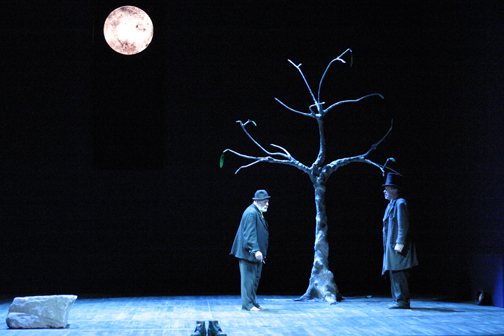
The existentialist meaninglessness of life is especially apparent in the abstract setting of Beckett's plays, stranding the characters in a world with no context, turing them into exiles both physically and spiritually. The plays are generally presented without context, reinforcing the detached nature of humanity and with only the barest of sets. The sparse stage set up of Waiting for Godot, for which Beckett provides the direction of A country road. A tree. Evening creating a suitably meaningless setting for a play about repetition and endless waiting.


In Endgame all of the action takes place in a single room filled with a sparse set of a chair, two trash cans and two windows. While Clov occasionally looks outside into the gray, all he reports is "Zero...zero....and zero," suggesting that this room really is all that is left. It has been suggested by some that the original stage direction,
Left and right back, high up, two small windows, curtains drawn.

Front right, a door. Hanging near door, its face to wall, a picture.

Front left, touching each other, covered with an old sheet, two ashbins.

Center, in an armchair on castors, covered with an old sheet, Hamm.


creates an image of a skull, symbolizing the death that seems to exist outside the windows as well as the characters own unreachable desire to end their lives.


This could be considered lavish however to the unnerving anti-set from his later play Not I, a lone beam of light focused on an actresses mouth, with all other light, including light from the theaters exit signs, extinguished. The extreme lack of context sends the audience adrift in a sea of darkness, unable to connect with the traditional signifiers of the theatre: the stage, the movement of actors and even the feeling of the other audience members around them. When these reliable aspects of a play are taken away so to is the audiences ability to live a life without examination. We are all exiles, in one form or another but that does not mean we should despair. Beckett's plays have always been tinged with dark humor, providing a small relief from such discouraging works. I find that this quote from Nell in Endgame provides a suitable description of the humor that is always present amidst the despair,


Nothing is funnier than unhappiness, I grant you that. ... Yes, yes, it's the most comical thing in the world. And we laugh, we laugh, with a will, in the beginning. But it's always the same thing. Yes, it's like the funny story we have heard too often, we still find it funny, but we don't laugh any more.

Beckett and the Cold War


Existentialism was strongly tied to the destruction of the World Wars, but as the horrors of World War II slowly started to fade they led to reconstruction and renewal. Still, the world did not stay at peace for long. The threat of war still lingered with America and the USSR, the two newly appointed super-power, stuck in a detente of strained relations and nuclear anxieties. The dread of this impending destruction tainted the new prosperity of America and Europe. Although it is unknown how Beckett reacted to this atmosphere it had an apparent effect on his work. As seen in the last post, Beckett does not provide much context or setting for his plays, letting the audience fill in the blanks. However, in Endgame, the barren gray setting, discussion concerning people who are dead and a general apocalyptic air provides a better idea than the rest. When Clov threatens to leave, Hamm warns "Outside of here it's death" and in a later scene Hamm and Clov have this exchange about nature:

HAMM:
Nature has forgotten us.
CLOV:
There's no more nature.
HAMM:
No more nature! You exaggerate.
CLOV:
In the vicinity.


Clov admits that life may still exist beyond his range of site but the characters are either too scared or unwilling to leave and find out. Although there are other interpretations, these references and the perpetual grayness of the landscape suggests that the play is set after a nuclear tragedy. Endgame was published in 1957, the height of fear over a potential nuclear war.

Concern over nuclear war manifested itself varied forms, some more apparent than others. :

Many family's prepared for the incoming war by building and stockingfallout shelters to save themselves from the nuclear aftermath. The link has a scanned copy of a fallout shelter manual from the 1960s. There is a strange counter-point between the idea of a nuclear war and the happy, well dressed family that populates the handbook. With their books, chemical toilet and a pack of cards they have everything they need to outlast the nuclear fallout with style. This schizophrenic attitude may be attributed to the prosperity of the time.

Not all remiders of a potential war were so carefree. The doomsday clock was created in 1947 by the directors of the Bulletin of the Atomic Scientists, portraying a stylized interpretation of how close our world is to nuclear destruction. The clock started at seven minutes to midnight with midnight being the start of a nuclear war. Throughout the years it has moved from a low of seventeen minutes to midnight in 1991 to a high of two minutes to midnight in 1953 to respond to closely time nuclear tests by Russia and the United States. The clock was most recently moved this year to six minutes to midnight. The Bulletin's website offers information on the current state of nuclear affairs as well as a timeline of the past state of nuclear affairs.


One final example shows the extent of fear of war as well as the naiveté of the public to the true effects of a bomb. This American film was first shown to school children in 1952 and uses a cartoon turtle to tell school children to duck and cover under their desks if the air raid sirens ever sound. The site CONELRAD refers to it as the The Citizen Kane of Public Defense and has an an extremely thorough description of the film and the rest of the atomic age.


Setting Endgame after a possible nuclear explosion serves as a literal cause for the characters inability to quit the endless cycle they live in. Hamm and Clov clearly hate living with each but are just as powerless to escape. They choose the having the company of someone to the unknown outside their small cabin. It is also interesting to people portrayed throughout this are all similar, white, middle class and attractive. When comparing these atomic age artifacts to Endgame it is interesting to note how different people portrayed are. Despite the fear that is ever-present in these pamphlets and videos, the people are always shown as proper examples of 1950's life, strong, white and well dressed. Compare this to the disabled rejects that populate Endgame, a man who cannot stand, his servant who cannot sit and his two parents who live in trash bins. In preparation for nuclear war everyone thought that the strongest, smartest people would be the survivors, but Beckett considers what if the rejects are the ones who are best suited to survive.


Conclusions


Literary critic Terry Eagleton, in his in-depth look at the phenomenon of exile in regards to Modernist literature, once sardonically noted,

"James, Conrad, Wilde, Shaw, Yeats, Joyce, Pound, Eliot, Beckett: if these are the chief luminaries of modern English literature, how come there isn't a decent, God-fearing Englishman among them?"

Although far from comprehensive, the object of this study was to examine the various motivations behind the self-imposed exiles of Joyce, Beckett, and Eliot in particular–three writers alike in many of their themes and experiences on the margins of European society. Eagleton continues by saying,

"They were all in-betweeners, caught between upper class and underdog, urban and rural, province and metropolis. Because of this, they could take in a wider range of experience than those ensconced in a single spot."

While it may be difficult to simplify this vast cultural movement, there is something to be said for the effect of such exiles on the literary works of these authors, all of whom published their respective magnum opi in a state of diaspora. In leaving America for England, Eliot gained a poetic persona, and it is often joked that he is more British than the British are. Some of his most influential pieces draw on the role of the outsider to convey a universal sense of alienation in a devastating post-war society. Using histories from across the globe, Eliot manages to compile something unique that distinctly captures the British experience after World War I, and sparked a revolution in literature that still extends today. Joyce and Beckett, on the other hand, brought to the table their own brand of post-colonialism, distancing themselves from their native Ireland as well as Britain in order to provide some sense of social commentary on the problems of their homeland. They deconstructed what it meant to write formal literature, and in doing so addressed similarly the limits of nationalism. Today, writers like Salman Rushdie embrace their Cosmopolitan heritage, belonging not to a specific country but rather being a citizen of the world, and his mentality finds its roots in the fragmented writings of Joyce and Beckett. In modern literature one's nationality because increasingly less important because, as Eagleton explains,

"The modernists were nomadic, in-between, adrift between cultures. Their home was art, not Birmingham or Bonn."