
Existentialism was strongly tied to the destruction of the World Wars, but as the horrors of World War II slowly started to fade they led to reconstruction and renewal. Still, the world did not stay at peace for long. The threat of war still lingered with America and the USSR, the two newly appointed super-power, stuck in a detente of strained relations and nuclear anxieties. The dread of this impending destruction tainted the new prosperity of America and Europe. Although it is unknown how Beckett reacted to this atmosphere it had an apparent effect on his work. As seen in the last post, Beckett does not provide much context or setting for his plays, letting the audience fill in the blanks. However, in Endgame, the barren gray setting, discussion concerning people who are dead and a general apocalyptic air provides a better idea than the rest. When Clov threatens to leave, Hamm warns "Outside of here it's death" and in a later scene Hamm and Clov have this exchange about nature:
HAMM:
Nature has forgotten us.
CLOV:
There's no more nature.
HAMM:
No more nature! You exaggerate.
CLOV:
In the vicinity.
Clov admits that life may still exist beyond his range of site but the characters are either too scared or unwilling to leave and find out. Although there are other interpretations, these references and the perpetual grayness of the landscape suggests that the play is set after a nuclear tragedy. Endgame was published in 1957, the height of fear over a potential nuclear war.
Concern over nuclear war manifested itself varied forms, some more apparent than others. :
Many family's prepared for the incoming war by building and stockingfallout shelters to save themselves from the nuclear aftermath. The link has a scanned copy of a fallout shelter manual from the 1960s. There is a strange counter-point between the idea of a nuclear war and the happy, well dressed family that populates the handbook. With their books, chemical toilet and a pack of cards they have everything they need to outlast the nuclear fallout with style. This schizophrenic attitude may be attributed to the prosperity of the time.
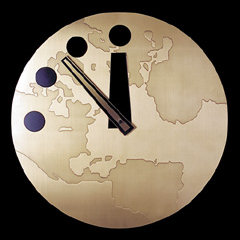
Not all remiders of a potential war were so carefree. The doomsday clock was created in 1947 by the directors of the Bulletin of the Atomic Scientists, portraying a stylized interpretation of how close our world is to nuclear destruction. The clock started at seven minutes to midnight with midnight being the start of a nuclear war. Throughout the years it has moved from a low of seventeen minutes to midnight in 1991 to a high of two minutes to midnight in 1953 to respond to closely time nuclear tests by Russia and the United States. The clock was most recently moved this year to six minutes to midnight. The Bulletin's website offers information on the current state of nuclear affairs as well as a timeline of the past state of nuclear affairs.
One final example shows the extent of fear of war as well as the naiveté of the public to the true effects of a bomb. This American film was first shown to school children in 1952 and uses a cartoon turtle to tell school children to duck and cover under their desks if the air raid sirens ever sound. The site CONELRAD refers to it as the The Citizen Kane of Public Defense and has an an extremely thorough description of the film and the rest of the atomic age.
Setting Endgame after a possible nuclear explosion serves as a literal cause for the characters inability to quit the endless cycle they live in. Hamm and Clov clearly hate living with each but are just as powerless to escape. They choose the having the company of someone to the unknown outside their small cabin. It is also interesting to people portrayed throughout this are all similar, white, middle class and attractive. When comparing these atomic age artifacts to Endgame it is interesting to note how different people portrayed are. Despite the fear that is ever-present in these pamphlets and videos, the people are always shown as proper examples of 1950's life, strong, white and well dressed. Compare this to the disabled rejects that populate Endgame, a man who cannot stand, his servant who cannot sit and his two parents who live in trash bins. In preparation for nuclear war everyone thought that the strongest, smartest people would be the survivors, but Beckett considers what if the rejects are the ones who are best suited to survive.


No comments:
Post a Comment