The devastation of the First World War shook Europe and the rest of the globe in a new and deeply profound way. Apart from the great political and economic ruin, the loss of an entire generation of young men drastically transformed the social structure of the nations involved. However, in the wake of this wreckage emerged a powerfully radical movement in art and literature: modernism. Disillusioned by greater social institutions like religion or government, modernism is characterized by a definitive break with tradition. Modernist works emphasize the overall subjectivity of existence, and are often fragmented, filled with obscure references to the larger canon of literature, and defined by feelings of alienation.

Around the same time as works like T.S. Eliot's The Waste Land and James Joyce's seminal Ulysses were being written and published, the world of art was being reevaluated as well. Where the "point" of a story or poem shifted from telling a story to portraying some emotion or experience, the same can be found in the visual media as well, like these two paintings by Kandinsky and Mondrian. By painting these abstract images and colors, Kandinsky and Mondrian found an outlet for expressing emotional perceptions. In the "Proteus" chapter of Ulysses, the protagonist Stephen is wandering along the beach thinking about what he calls the "ineluctable modality of the visible," or the failure of sense to adequately capture the outside world. Kandinsky and Mondrian similarly believed that what is seen is inherently false, and that true reality couldn’t be captured in any visual image, so they focused on expressing their individual experiences alone.

It is interesting to consider how the Modernist painters developed the theme of alienation through their artwork. In this painting by Mondrian, for example, the return to primary colors (red, blue, and yellow) suggests the failure of advancement to adequately provide for their needs. There is new emphasis placed on the formal elements, like shapes and lines, as if what is being said is possibly secondary in importance to how it is being said. Although the red is undeniably the largest block of color in the frame, it doesn't seem unbalanced, but rather the tension of the painting stems from the juxtaposition of neutral black and white to "hold in" the fiery red. Because there is no human or other discernible figure in the painting, the meaning must be derived in the connection of the viewer to the canvas. It goes back to Ulysses' mediation on perception, and Mondrian's painting invites the eye to take it in by focusing on what is essential to sight, these specific colors. When the contrasting shades of black and white are added, the composition becomes an allegory for possibility, and the very nature of existence (although it is also important to emphasize the inherent subjectivity of an analysis like this!)
To further develop the rooted theme of alienation, another connection these artists have to the many other great leaders of the modernist movement like Joyce, Stravinsky, Bartok, Picasso, Miro, Pound, Hemingway, Fitzgerald, Auden, Huxley, Mann, Eliot and Beckett, is that all their creative masterpieces were created in states of exile, either because of war or for other personal reasons. The early-to-mid twentieth century was a time of great paradigmatic shifts in society, where national loyalty was being questioned and where the international political superpowers were changing in shocking ways. Britain, who once controlled half the world, was facing the apocalyptic aftermath of WWI and being eclipsed by their formal colony the United States, financially, politically and even culturally. Few of the great British writers on the early 20th century originated or stayed long in Britain and, as literary critic Terry Eagleton best describes it, Britain had sunk to the point where it was forced to import its modernists.
Nevertheless, this distance gave the writers and painters an interesting role as outsiders commentating on the social state of affairs.
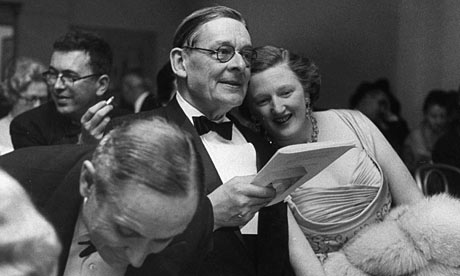
Among the many articles written on this topic, Doris Elder in "Three Writers in Exile" poses the following questions at the end of its introduction, that may be useful to keep in mind in regards to three authors in particular: T.S. Eliot, James Joyce, and Samuel Beckett, all of whom defined their field through their new and innovative writing, all the while in exile.
Why did each writer settle where he did?
How did exile make possible or facilitate his work?
How did each writer influence his chosen environment and, likewise, how did his environment influence him?
What did each writer retain of his native heritage?
What do these authors' works reveal of the state of American, British, and European culture during the first half of this century?
What can we learn about the problem of the alienation of the modern artist by studying the lives and works of Beckett, Eliot, and Joyce?
Eliot summed it up the best in his poem The Four Quartets
where he says:
We shall not cease from exploration, and the end of all our exploring will be to arrive where we started and know the place for the first time.